Tag: Psychology

History of Psychology – Radical Behaviourism


Radical behaviourism is an offshoot of behaviourism which was first described by B.F Skinner. Radical behaviourism is different from earlier ideas of behaviourism because, rather than ignoring internal states like emotions and thoughts, it viewed them as just another type of behaviour, meaning that they could be measured and determined in the same way as observable actions.
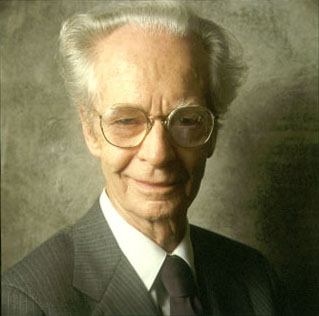
An image of B.F. Skinner. (I’d also use just my initials if my first name was Bhurrus).

One radical behaviourist was Clark Hull, who believed all human behaviour could be explained in terms of physics and maths – he was quoted as saying “a psychologist should not only understand mathematics, but think in mathematics”. Hull’s Mathematico-Deductive Theory was based on creating precise, standardised definitions for factors which affected the probability that a specific Stimulus would lead to a specific Response.

Naming that probability “E”, for Excitation Potential, Hull tried to transform identified factors, such as Inhibition, Fatigue and Motivation, into mathematical functions that predicted people’s behaviour.

This produced mathematical formulae that he believed explained behaviour, such as E = (sHr x D x K x V x J). That formula says: the probability of the Response happening is equal to the number of times the person has been trained to associate the Stimulus with the Response (sHr), multiplied by the person’s motivation to perform the Response (D), multiplied by the size of the Response (K), multiplied by how intense the Stimulus was (V), multiplied by the delay between the Stimulus and Response (J).

Each variable was given a precise operational definition, to aid Hull’s research and replication. Hull hoped to make psychology as scientific and precise in its predictions as physics or chemistry.

Continue reading

History of Psychology – The First Behaviourist

Despite Thorndike discovering one of the fundamental principles of behaviourism, he was not the first behavioural psychologist- that honour goes to John Watson.

Watson was – as many of the early psychologists and scientists seem to be- a precocious student, starting college at the age of 16. The combined influence of two of his teachers, especially their belief that all behaviour could be explained by chemistry and physics with no spiritual or moral driving force, led Watson to develop his philosophy of psychology.

“Psychology as the Behaviourist views it”, otherwise known as the “Behaviourist Manifesto”, rejected the old Structuralist methods by stating that “introspection forms no essential part of its method”. It also stood opposite the psychodynamic thinkers, who saw humans as uniquely complex: the Manifesto saw humans as simply more refined animals- “the behaviourist…recognizes no dividing line between man and brute”.

The Manifesto was largely ignored by psychologists when it was first written, as the only principle of behaviour Watson had at the time to support his views was Pavlov’s discovery of reflexes. However, it became more prominent after Watson applied his philosophy to raising children.

Continue reading

History of Psychology – Behaviourism 101

The beginnings of behaviourism overlap in terms of time with psychodynamics, as both started and grew during the first two decades of the 20th century.However, they are complete opposites in content; while the psychodynamic psychologists considered the unconscious mind to be the irrational driving force behind almost all behaviour, behaviourists ignore it completely.

The main principle behind Behaviourism is that every behaviour we do is learnt from our environments, as a stimulus in the environment causes a response from us. These S-R bonds rely on the concept of “conditioning”- the association between two stimuli in classical conditioning, and the association between a stimulus and a response in operant conditioning. However, the actual internal processes that link them is ignored,  and seen as the mysterious and un-knowable “black box” connecting stimuli and responses.

Continue reading

History of Psychology – Finally, some female psychologists…

Today’s post will be talking about two of the first women in psychology.  They’re sharing a post as they were both working at the same time and influenced by the other’s work.

The first of these is Anna Freud, who was the daughter of Sigmund Freud and one of the few associates who remained faithful to his ideas. She built on his concepts of the psyche and the unconscious, but placed stronger focus on the ego than the id- most of Freud’s book on Ego defence mechanisms was actually Anna’s work. For this reason, the next movement in psychodynamic psychology became known as Ego psychology.

Anna also applied her and Sigmund’s work to dealing with children, instead of dealing with childhood recollections from adults. She also made psychodynamic psychology slightly more scientific by using of natural experiments and longitudinal studies on the children she worked with.

Continue reading

Jung-the unconcious explorer

While most psychologists I’ve written about so far are either strongly scientific or strongly against science, Jung is somewhere inbetween. In his early years, he tried to study very unscientific things such as dreams in a scientific way, so still considered himself a scientist despite being a psychodynamic psychologist.

One of the most famous pairings in psychology is the meeting of minds between Freud and Jung. The first time they met, while both studying schizophrenia, they reportedly talked for 13 hours straight. They joined forces, developing a  father-son relationship- Jung became the crown prince to Freud’s kingdom of psychoanalysis.

Continue reading

History of Psychology – Introducing Freud…

If James and Wundt are the fathers of psychology, Freud can best be described as psychology’s slightly senile great-uncle.

A surprising thing about Freud is that he originally intended to be a medical psychopathologist, and was only directed towards his famous approach by his mentor Joseph Breuer. Breuer and Freud collaborated studying “Anna O.”, who developed many different hysterical symptoms after caring for her ill father for months. They found she would go into states that looked like trances and during them would recall memories related to her current symptoms. The symptoms would then disappear afterwards, to be replaced by new ones. Anna called this “chimney sweeping”, and this treatment was probably what inspired Freud to keep studying the hysterical, irrational aspects of the mind.

Continue reading

History of Psychology – William James

The second “father of experimental psychology” was American doctor and philosopher William James. James viewed psychology as a natural science, believing in the same way as Wundt that feelings and reasonings could be analysed by their smaller features. However, James is regarded as the founder of Functionalism, the second psychological school of thought, not as a Structuralist.

Functionalism started from the same point as, and was a reaction to, Structuralism. Functionalism was slightly different because it focused on the purpose and adaptation of consciousness rather than just the process of breaking it into smaller elements.

Continue reading

History of Psychology – The First Psychologist?

While the mind as a philosophical subject has been around since ancient cultures,attempts to study it scientifically didn’t become widespread until the 1800s.

The person who first began to study psychology using experiments and research was Wilhelm Wundt, known as one of the two the “fathers of experimental Psychology”-the other being William James. As well as psychology, Wundt studied philosophy, physics and physiology – his work in all of those areas can be seen as “foundationalist”, meaning he tried to find the basic beliefs in each discipline that everything else is based on. His ideas were often drawn from philosophers, so used concepts such as materialism and idealism.

Continue reading

Audience Participation Required…

Instead of a normal blog post, this is a vote post.

While researching my intended next post, I ended up going in lots of directions at once, and now don’t know which to follow, so I thought I’d ask the people who are hopefully going to read it, and see which you would be intetested in.

Anyhow, here are your three current options, although other suggestions are always welcome.

1) A history of famous psychologists series
2) A cognitive bias series (cognitive biases are errors in the way we percieve/interpret the world, and things that happen to us)
3) A crash-course in psychological approaches.

Happy voting!

Psychiatry, Burnout and Dictatorship, Pt.2

Here is Pt.1, if you’ve arrived at this one first.

In the first post on this topic, I wrote about my reading on the Burnout Cycle and Compassion Fatigue, and how I saw a link between this combination and the consequences of dictatorship. So now I’ll explain the details of the burnout cycle and show how they can be observed to an extent in some previous dictatorships.

The term “burnout” describes a form of exhaustion caused by high stress levels, most commonly from workplace stress. The cycle of burnout has 12 phases, which are categorised as mild, moderate or severe .

Continue reading